
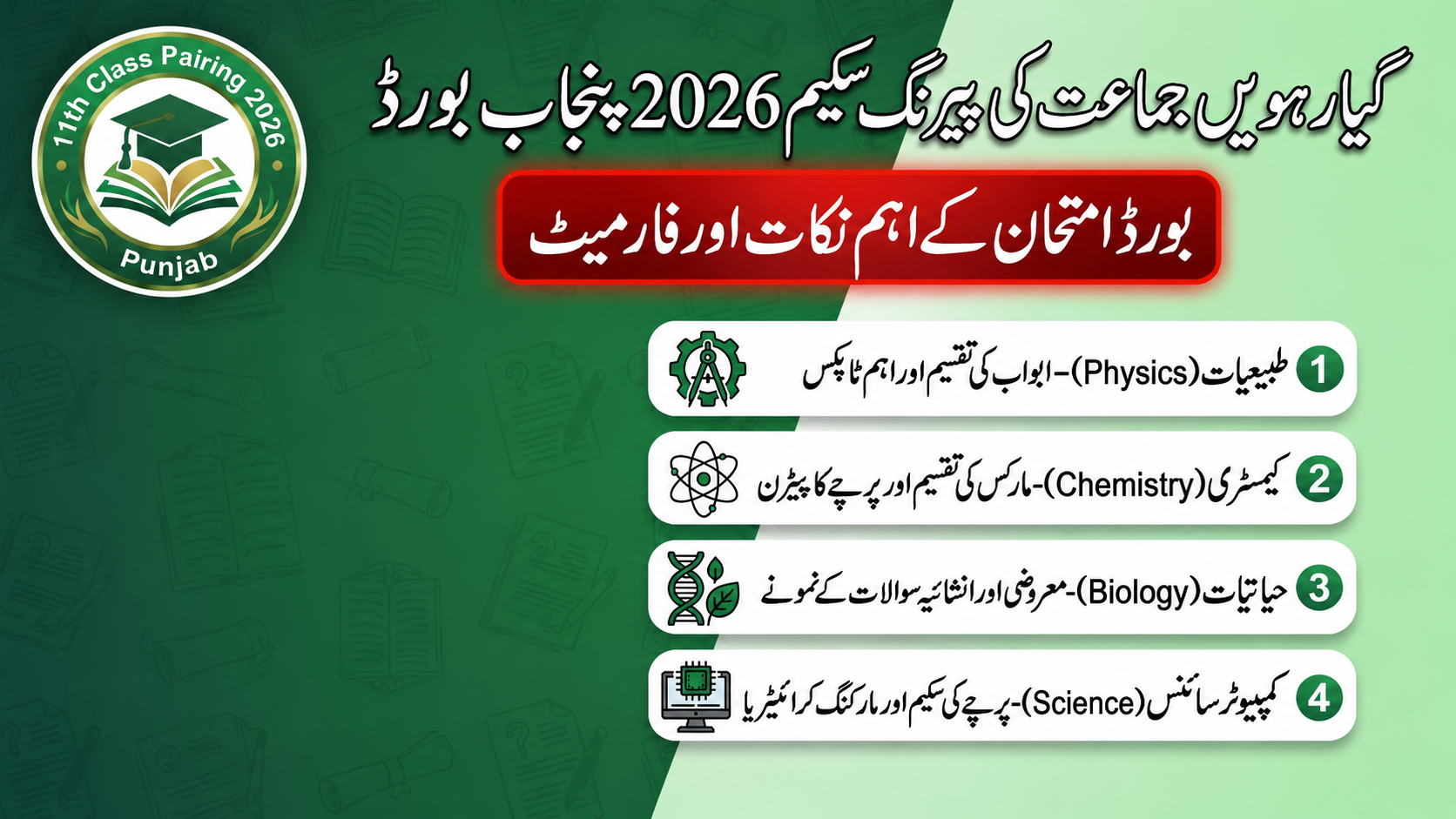
Preparing for 11th class exams can be challenging, especially when you are unsure about the paper pattern, important chapters, and topics to prioritize. At the intermediate level, subjects are more detailed and demanding than matric, so having a clear study plan becomes essential.
The 11th Class Pairing Scheme 2026 makes exam preparation easier by helping students understand the expected paper pattern, chapter-wise distribution, and important topics. It provides a useful roadmap for organizing your studies and focusing more attention on areas that are likely to be important in the exam.
Instead of studying every topic without a proper strategy, students can use the 1st Year Pairing Scheme 2026 as a guide, revise strategically, and manage their preparation time more effectively. Combined with textbooks, notes, past papers, and regular practice, the pairing scheme can help you prepare with greater confidence and improve your chances of achieving better marks.
Punjab Boards 11th Class Pairing Scheme 2026 – Subject-Wise Paper Pattern
The 9th Class Paper Scheme 2026 for Punjab Boards provides students with a structured overview of the expected exam pattern and question distribution. Major Punjab Boards, including Lahore, Gujranwala, Faisalabad, Multan, Rawalpindi, Sargodha, Bahawalpur, DG Khan, and Sahiwal, follow board-specific examination patterns that help students understand how questions may be distributed across different sections.
The 9th Class Pairing Scheme 2026 is also useful for students preparing under other Pakistani education boards, such as the Sindh Boards, KPK Boards, and Federal Board. However, the exact paper pattern, chapter distribution, and question format can vary from one board to another. Students should always check the latest scheme issued for their respective board and subject.
Key Features of the 9th Class Paper Scheme 2026
- Covers major education boards across Pakistan, with separate patterns where applicable.
- Includes important subjects such as Mathematics, Physics, Chemistry, Biology, English, Urdu, Islamiat, and Pakistan Studies.
- Explains the distribution of MCQs, short questions, and long questions in the examination.
- Shows how questions may be selected from different chapters and topics.
- Helps students identify important areas and organize their 9th class exam preparation more effectively.
- Provides a useful roadmap for understanding the latest 9th class paper pattern 2026.
9th Class Paper Pattern 2026 Overview
The examination paper is generally divided into three major sections:
- MCQs (Objective): Questions are selected from the prescribed syllabus and relevant chapters.
- Short Questions: Questions are distributed across different chapters according to the subject’s examination pattern.
- Long Questions: These may include internal choices, with questions often arranged according to the prescribed chapter or unit distribution.
Using the 9th Class Pairing Scheme 2026 alongside your textbook, class notes, past papers, and regular practice can make exam preparation more organized. Rather than relying only on selected questions, students should use the scheme as a study guide while covering the complete syllabus.
Subject Wise Pairing Scheme
Each subject follows its own paper pattern and question distribution. Students should use the 9th Class Pairing Scheme 2026 as a study guide to prioritize important topics, organize their preparation, and maximize their chances of scoring higher marks.
Physics 11th Class Pairing Scheme
Physics covers a combination of numerical problems, theoretical questions, derivations, and conceptual topics. The 9th Class Physics Pairing Scheme 2026 helps students understand the expected question distribution and prepare effectively for both conceptual and numerical questions.
Short Questions Pairing
| Question No. | Chapter Pairing |
|---|---|
| Q2 | Chapter 1 / Chapter 2 / Chapter 3 |
| Q3 | Chapter 4 / Chapter 5 |
| Q4 | Chapter 6 / Chapter 7 |
| Q5 | Chapter 8 / Chapter 9 |
Long Questions Pairing
| Question No. | Chapters |
|---|---|
| Q6 | Chapter 1 + Chapter 2 |
| Q7 | Chapter 3 + Chapter 4 |
| Q8 | Chapter 5 + Chapter 6 |
| Q9 | Chapter 7 + Chapter 8 |
Chemistry Pairing Scheme 2026 – Chapter-Wise Paper Pattern & Marks Distribution
Chemistry requires a strong understanding of concepts, chemical reactions, and numerical problems. The Chemistry Pairing Scheme 2026 helps students identify important chapters, focus their exam preparation, and prioritize topics that are more likely to appear in the paper.
MCQs Distribution
| Chapter | MCQs | Chapter | MCQs |
|---|---|---|---|
| Chapter 1 | 2 | Chapter 6 | 1 |
| Chapter 2 | 2 | Chapter 7 | 1 |
| Chapter 3 | 2 | Chapter 8 | 1 |
| Chapter 4 | 2 | Chapter 9 | 1 |
| Chapter 5 | 2 | — | — |
Short Questions
| Question | Chapters |
|---|---|
| Q2 | Chapter 1, Chapter 2 |
| Q3 | Chapter 3, Chapter 4 |
| Q4 | Chapter 5, Chapter 6 |
| Q5 | Chapter 7, Chapter 8 |
Long Questions
| Question | Chapters |
|---|---|
| Q6 | Chapter 1 / Chapter 2 |
| Q7 | Chapter 3 / Chapter 4 |
| Q8 | Chapter 5 / Chapter 6 |
| Q9 | Chapter 7 / Chapter 8 |
11th Class Biology Pairing Scheme 2026 – 1st Year Chapter-Wise Paper Pattern
Biology is primarily a theory-based subject that focuses on concepts, detailed explanations, and well-labeled diagrams.
MCQs Distribution
| Chapter | MCQs | Chapter | MCQs |
|---|---|---|---|
| Chapter 1 | 2 | Chapter 6 | 1 |
| Chapter 2 | 2 | Chapter 7 | 1 |
| Chapter 3 | 2 | Chapter 8 | 1 |
| Chapter 4 | 2 | Chapter 9 | 1 |
| Chapter 5 | 2 | — | — |
Short Questions
| Question | Chapters |
|---|---|
| Q2 | Chapter 1, Chapter 2 |
| Q3 | Chapter 3, Chapter 4 |
| Q4 | Chapter 5, Chapter 6 |
| Q5 | Chapter 7, Chapter 8 |
Long Questions
| Question | Chapters |
|---|---|
| Q6 | Chapter 1 / Chapter 2 |
| Q7 | Chapter 3 / Chapter 4 |
| Q8 | Chapter 5 / Chapter 6 |
| Q9 | Chapter 7 / Chapter 8 |
11th Class Mathematics Pairing Scheme 2026 – 1st Year Chapter-Wise Paper Pattern
Mathematics requires consistent practice, formula revision, and strong conceptual understanding. The 11th Class Mathematics Pairing Scheme 2026 helps students identify the chapter-wise question distribution and focus their preparation on the most important topics.
MCQs Distribution
| Chapter | MCQs | Chapter | MCQs |
|---|---|---|---|
| Chapter 1 | 1 | Chapter 7 | 1 |
| Chapter 2 | 1 | Chapter 8 | 1 |
| Chapter 3 | 1 | Chapter 9 | 1 |
| Chapter 4 | 1 | Chapter 10 | 1 |
| Chapter 5 | 1 | Chapter 11 | 1 |
| Chapter 6 | 1 | — | — |
11th Class Mathematics Short Questions Pairing 2026 – Chapter-Wise Scheme
| Question No. | Chapters |
|---|---|
| Q2 | Chapter 1 / Chapter 2 |
| Q3 | Chapter 3 / Chapter 4 |
| Q4 | Chapter 5 / Chapter 6 |
| Q5 | Chapter 7 / Chapter 8 |
| Q6 | Chapter 9 / Chapter 10 |
Long Questions Pairing
| Question | Chapters |
|---|---|
| Q7 | Chapter 1 + Chapter 2 |
| Q8 | Chapter 3 + Chapter 4 |
| Q9 | Chapter 5 + Chapter 6 |
11th Class Computer Science & ICS Pairing Scheme 2026 – Subject-Wise Paper Pattern
For ICS (Intermediate in Computer Science) students, the 11th Class Pairing Scheme 2026 covers both theoretical concepts and practical skills, helping students understand the paper pattern and prepare each topic more effectively.
Short Questions Pattern
| Question No. | Chapters Covered | Attempt |
|---|---|---|
| Q2 | Chapter 1, Chapter 2, Chapter 3 | Attempt any |
| Q3 | Chapter 4, Chapter 5, Chapter 6 | Attempt any |
| Q4 | Chapter 7, Chapter 8, Chapter 9 | Attempt any |
The 11th Class Computer Science short questions generally focus on fundamental concepts and concise answers from the prescribed syllabus. Students should prepare the following areas carefully:
- Definitions: Important terms, concepts, and key terminology from each chapter.
- Differences: Comparisons between related programming concepts, methods, or technologies.
- Basic Programming Concepts: Fundamental programming principles, syntax, logic, and problem-solving concepts.
- Short Theory Questions: Brief explanations of important theoretical topics and computer science concepts.
For better exam preparation, revise these topics chapter-wise and practice 11th Class Computer Science short questions from textbooks and past papers alongside the pairing scheme 2026.
Long Questions
| Question No. | Chapters |
|---|---|
| Q5 | Chapter 1 / Chapter 2 |
| Q6 | Chapter 3 / Chapter 4 |
| Q7 | Chapter 5 / Chapter 6 |
| Q8 | Chapter 7 |
MCQs
| Chapter | MCQs | Chapter | MCQs |
|---|---|---|---|
| Chapter 1 | 2 | Chapter 6 | 1 |
| Chapter 2 | 2 | Chapter 7 | 1 |
| Chapter 3 | 2 | Chapter 8 | 1 |
| Chapter 4 | 1 | Chapter 9 | 1 |
| Chapter 5 | 1 | — | — |
The 11th Class English paper covers several important areas, including:
- Comprehension: Reading passages followed by questions to test understanding.
- Essays: Practice of important essay topics and effective writing techniques.
- Letters & Applications: Preparation of commonly asked formats and proper writing structure.
- Grammar: Essential grammar rules, sentence structure, and language usage.
The 11th Class English Pairing Scheme 2026 helps students understand the paper pattern and prioritize important writing formats, comprehension practice, and key grammar topics for more effective exam preparation.
The 11th Class Urdu paper covers several key areas, including:
- مضامین (Mazameen): Important essay topics and structured Urdu writing.
- قواعد (Grammar): Essential Urdu grammar rules and language concepts.
- ترجمہ (Translation): Translation-based questions designed to assess language understanding.
- تفہیم (Comprehension): Reading passages and questions based on comprehension skills.
The 11th Class Urdu Pairing Scheme 2026 helps students identify important sections and organize their selective preparation more effectively. For better results, students should use the scheme as a study guide while preparing the complete syllabus.
The 11th Class Islamiat paper covers several important areas that students should prepare carefully, including:
- Quranic Ayats: Important verses along with their meanings, translations, and explanations.
- Ahadith: Selected Ahadith and their meanings, teachings, and relevant concepts.
- Short Questions: Key questions based on important chapters, Islamic teachings, and concepts.
- Islamic Concepts: Fundamental beliefs, principles, values, and teachings included in the prescribed syllabus.
The 11th Class Islamiat Pairing Scheme 2026 can help students identify important and frequently tested topics, organize their revision, and prepare more effectively. However, students should cover the complete syllabus instead of relying solely on selective preparation.
11th Class Pakistan Studies Pairing Scheme 2026 – Chapter-Wise Paper Pattern
The 11th Class Pakistan Studies paper covers several important sections, including:
- Objective Portion: MCQs based on key facts, dates, personalities, and concepts.
- Historical Questions: Questions covering important events, movements, personalities, and developments in the history of Pakistan.
- Long Analytical Questions: Detailed questions that assess students’ understanding of major historical events and national concepts.
The 11th Class Pakistan Studies Pairing Scheme 2026 helps students identify important historical events, key concepts, and major topics, allowing them to organize their exam preparation and revision more effectively.
Why 11th Class Pairing Scheme 2026 Matters
The 11th Class Pairing Scheme 2026 is a useful study guide that helps students prepare for board exams in a more organized and focused way. It provides an overview of the paper pattern, chapter-wise question distribution, and important topics, making it easier to plan revision without unnecessary guesswork.
Benefits of the 11th Class Pairing Scheme
Saves valuable study time by helping students prioritize important chapters and topics.
Explains the paper pattern so students can understand how different questions may be distributed.
Reduces exam stress and confusion by providing a clear preparation roadmap.
Supports better marks preparation by allowing students to focus on high-priority areas.
Makes revision more organized through a structured, subject-wise study plan.
Best Preparation Strategy for 11th Class Exams
For effective exam preparation, students should:
Study the important chapters and topics highlighted in the pairing scheme.
Practice past papers and previous board questions regularly.
Review frequently asked and repeated questions to strengthen preparation.
Revise each subject according to its latest paper pattern and pairing scheme.
Continue studying the complete syllabus, using the pairing scheme as a planning tool rather than relying on selective preparation alone.
A combination of the 11th Class Pairing Scheme 2026, textbooks, notes, past papers, and regular revision can help students prepare confidently and perform better in Punjab and other Pakistan board examinations.
Frequently Asked Questions About 11th Class Pairing Scheme 2026
Find quick answers to common questions about the 11th Class Pairing Scheme, paper pattern, subjects, and exam preparation.
What is the 11th Class Pairing Scheme 2026? +
The 11th Class Pairing Scheme 2026 is a study guide that explains the expected paper pattern and chapter-wise distribution of questions. It helps students organize their preparation and identify important areas for revision.
Is the 11th Class Pairing Scheme 2026 available for all subjects? +
Yes. Pairing schemes are commonly available for major 11th class subjects, including Physics, Chemistry, Biology, Mathematics, Computer Science, English, Urdu, Islamiat, and Pakistan Studies, depending on the board and current examination pattern.
Does the pairing scheme guarantee questions in the exam? +
No. A pairing scheme should be used as a preparation guide rather than a guarantee of exact exam questions. Students should prepare the complete syllabus and use the scheme to understand the expected question distribution.
How can I use the 1st Year Pairing Scheme 2026 for exam preparation? +
Start by reviewing the chapter-wise question distribution, then prioritize important topics and revise them regularly. For stronger preparation, combine the 1st Year Pairing Scheme 2026 with textbooks, notes, past papers, and practice questions.
Are pairing schemes the same for all Punjab Boards? +
The overall paper structure may be similar across Punjab Boards, but the exact chapter distribution, question pattern, and subject scheme can vary. Students should always follow the latest scheme applicable to their own board.
Can I score good marks by studying only the pairing scheme? +
Relying only on the pairing scheme is not recommended. To achieve good marks in the 11th class exams 2026, students should cover the complete syllabus and use the pairing scheme together with past papers, textbook exercises, and regular revision.
What is the best way to prepare for 11th class board exams? +
The best approach is to create a realistic study schedule, understand the paper pattern, revise important chapters, practice past papers, and regularly review difficult topics. Using the 11th Class Pairing Scheme 2026 can make your preparation more focused and organized.